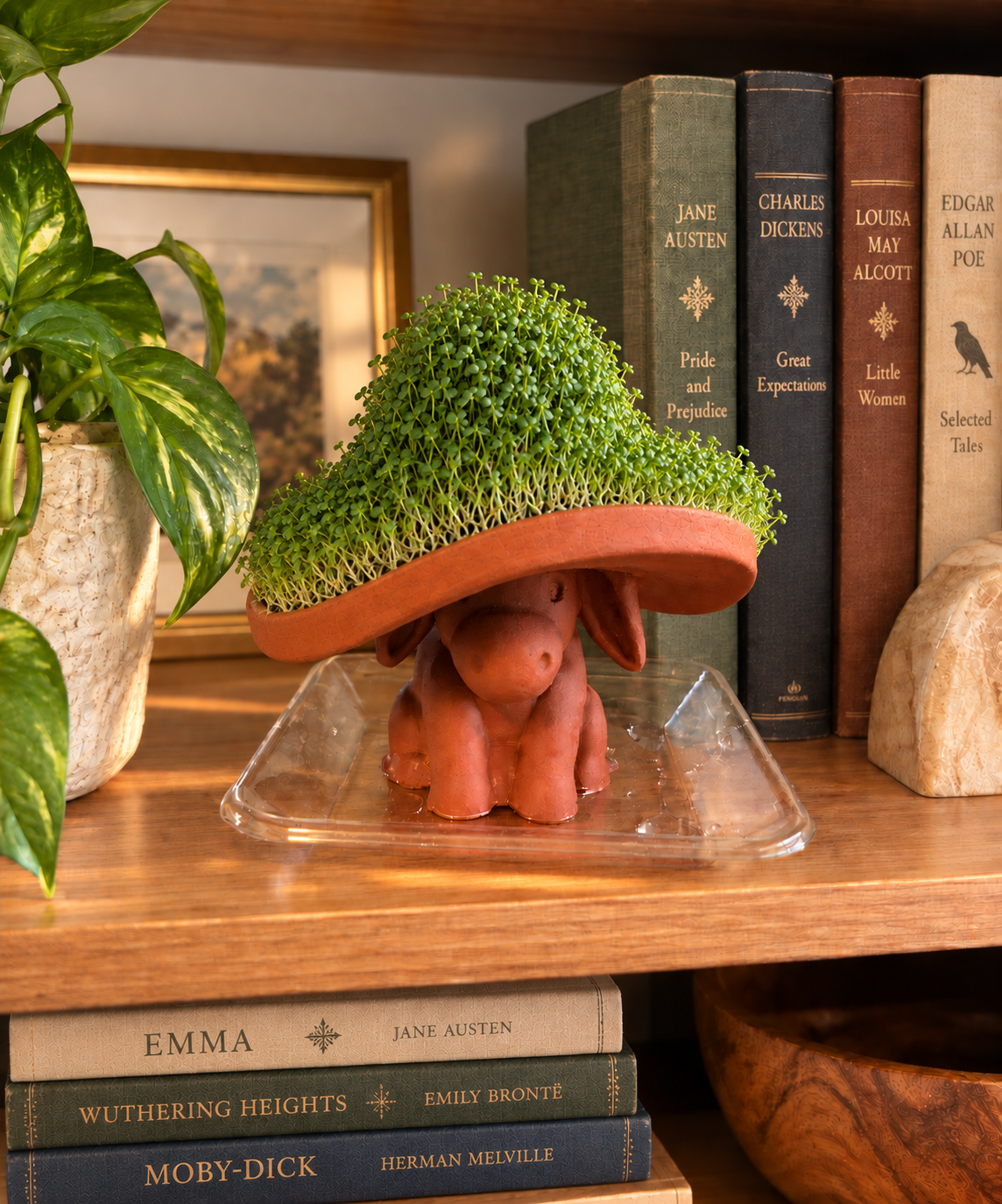
A few nights ago, I soaked some chia seeds in water. This was not an act of personal wellness. I am developing a terracotta donkey named Graciass whose sombrero is supposed to grow lush chia, and before I commit to making a thousand of them, I needed to establish that he could, in fact, grow hair.
The instructions seemed simple enough: soak the seeds, mix them into a paste, spread the paste over the sombrero, and keep it moist. I did all of that. Then I went to bed, apparently expecting fully established foliage by morning.
When I got out of bed, I immediately inspected the seeds. Nothing had changed. Or at least nothing I could see. They looked almost exactly as they had the night before, perhaps a little drier.
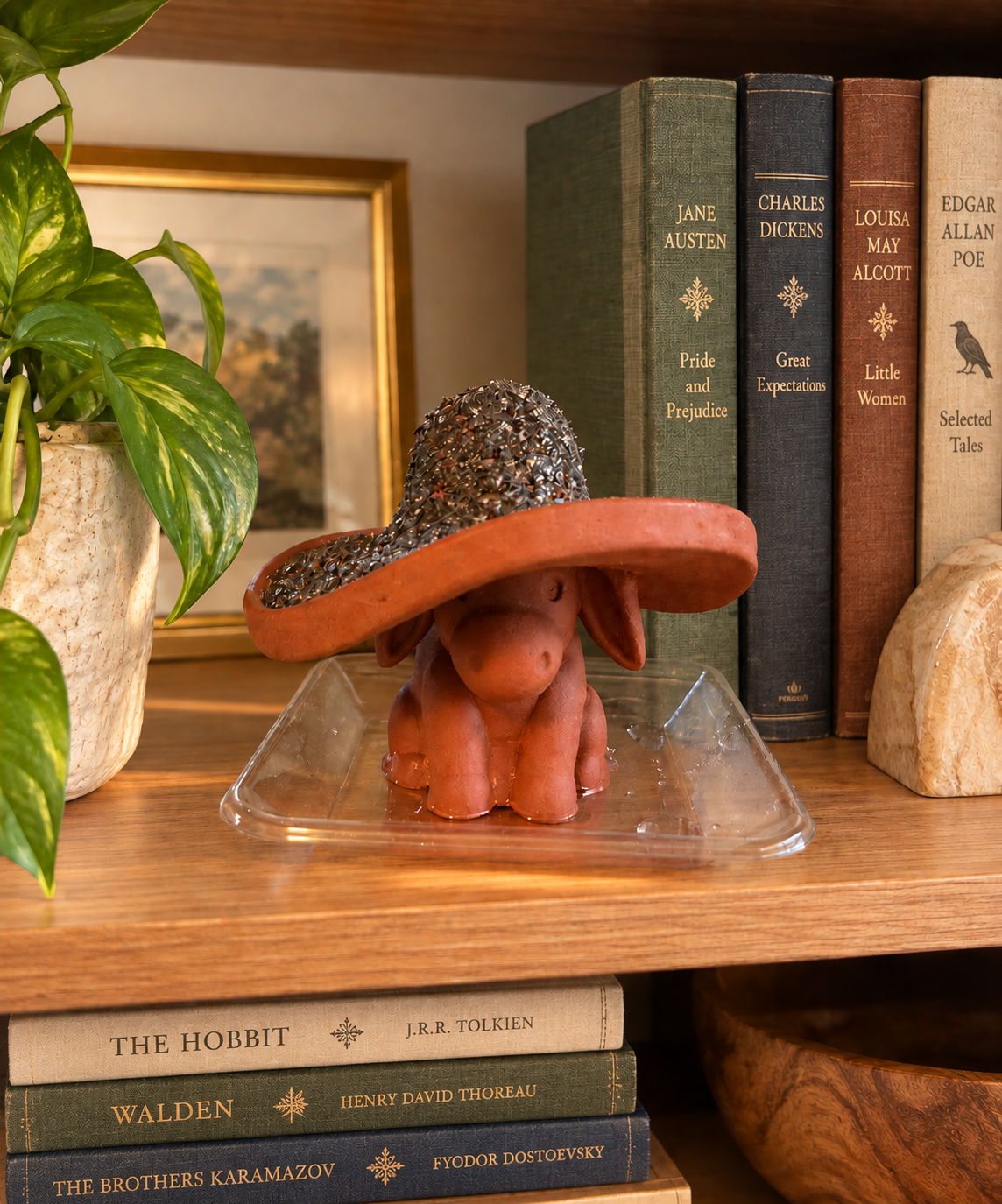
I misted them and looked closer. Were they swelling? I took a picture and compared it with pictures of germinating chia. I wondered whether I had made the paste too thick, used too much water, used too little water, or failed to provide enough air.
I had given them approximately twelve hours to become plants, and frankly, I was concerned about their progress.
The ridiculous thing is that I know how seeds work. You put them in the right conditions, and then, for a while, seemingly nothing happens.
The seed does not provide a progress report. It does not reassure you that it received the water and is currently working on germination. There is simply a period of time when you cannot see what is happening.
And yet I wanted evidence. I was making a huge investment in Graciass. I was taking a leap of faith. I wanted some tiny green shoot to tell me: It’s working. It’s going to be worth it.
Charles Haanel wrote about this more than a hundred years ago in The Master Key System. He described the oak, the rose, and the lily as having a kind of “silent demand” for what they need in order to reach their ultimate and individual potential.
Haanel calls it their “most perfect expression.”
I love that idea.
A seed is not waiting around for us to tell it what to do. It is seeking growth. That is what living things do. Plants need different combinations of nutrients at different rates, and somehow they draw what they need out of the ground. When you think about it, it is kind of mind-blowing.
There is something inside the seed already moving toward what it will become.
Give it water, light, nutrients, space, and time, and something begins happening that we cannot see and do not control.
Haanel also wrote about the tendency to plant a seed and then become so anxious about whether it is growing that we disturb the soil to check.
Which, of course, is exactly what I wanted to do that morning.
Just a little checking. A little helping. Perhaps a little intervention.
Because what if nothing was happening?
Or maybe worse: What if I had done something wrong and needed to correct it immediately?
I wonder how often we do this with our children.
We want evidence that what we are teaching is working. We want to know that therapy is helping, tutoring is worth the effort, and our children are becoming responsible and learning from their mistakes.
We want evidence that they will make friends, find their way, become independent, recover from disappointment, make good decisions, figure out school, choose a direction, and become people who will be okay in the world.
And when we cannot see the evidence, we start digging.
We remind, correct, advise, lecture, research, rescue, monitor, and fix. We check the grades again. We ask who they sat with at lunch. We email the teacher. We find another tutor. We suggest what they could say to a friend. We explain the lesson one more time because perhaps they didn’t understand it before.
Individually, any of these things might be useful.
But sometimes underneath all of them is the same anxious thought:
My child isn’t growing correctly or quickly enough, so I need to do more.
And underneath even that is something I think many of us believe without realizing we believe it:
If I do parenting correctly, I will be able to produce the outcome I want.
That is a heavy job description.
It also explains why it can be so difficult to stop digging.
We aren’t only worried about the seed. We are using the seed’s progress to evaluate the gardener.
If my child is struggling in school, maybe I haven’t taught responsibility well enough. If she doesn’t have friends, maybe I haven’t helped enough. If he makes a terrible decision, maybe I should have seen it coming. If she is anxious, perhaps I didn’t make her confident enough. If he doesn’t launch on my preferred timeline, maybe I failed to prepare him. If she rejects something deeply important to me, perhaps I failed to teach it correctly.
No wonder we are exhausted.
We have given ourselves responsibility for producing another human being.
I think we sometimes approach parenting as though we were architects instead of gardeners.
An architect begins with a blueprint. Before construction starts, someone has decided how tall the building will be, where the walls and windows will go, and how the rooms will be arranged.
Then construction begins, and the goal is for the finished building to match the plan.
We can unconsciously do this with our children.
We have blueprints for who we hope they will become: kind, responsible, hardworking, confident, emotionally regulated, successful, independent, and close to both their siblings and us.
Maybe we picture a doctor, a lawyer, or at least a college graduate. Maybe we imagine someone who marries, has children, shares our values, manages money well, and makes the decisions we believe will lead to a good life.
There is nothing wrong with wanting beautiful things for our children.
Vision matters enormously.
But a vision is not a blueprint.
Our children are not buildings.
They are alive.
And living things participate in their own becoming.
A seed contains something an architect’s pile of lumber never will: its own direction, timing, possibility, potential, and perfect expression.
A gardener can influence almost everything surrounding a seed.
She can prepare rich soil, provide water and light, protect a tender shoot from frost, pull weeds, stake a young plant against the wind, pay attention, learn, respond, and cultivate.
But she cannot reach inside the seed and tell it to grow faster. A seed does not grow because it is watched. Pulling on the stem will not make it taller. An acorn cannot be instructed on how to grow into a maple tree.
There is a strange humility in gardening.
You matter tremendously, and you are not in charge.
Parenting asks us to hold those two truths at the same time.
None of this means the gardener doesn’t matter.
The soil matters. Water matters. Light matters. Protection matters. A gardener can create conditions that make growth easier or harder.
That is precisely why parenting matters so much.
But I wonder if sometimes we confuse influence with control.
I have enormous influence over the soil.
I do not control what the seed does with it.
That changes where I put my vision. Instead of having a vision for exactly who my child will become, I can have a vision for what I will provide while they are becoming.
What kind of soil do I want our home to be?
What do I want to value, model, demonstrate, and teach? Do I want this to be a place where failure is survivable, feelings are allowed, boundaries mean something, people apologize, repair happens, work matters, curiosity is encouraged, and love does not have to be earned?
And I can have a vision for myself.
Who do I want to be while they are growing?
Do I want to be someone who trusts and listens, teaches and holds boundaries, and allows another person to struggle without immediately deciding that the struggle means something has gone wrong?
Do I want to be someone who does not expect perfection from myself or my children?
Someone who can recognize the difference between tending the soil and digging up the seed?
That may be one of the most useful questions we can ask ourselves when the panic to do something arrives:
Am I tending the soil, or am I digging up the seed?
A child gets a D.
Maybe tending the soil means setting expectations, offering structure, arranging tutoring, or helping him understand what happened.
Digging might be checking the portal six times a day, lecturing, catastrophizing about college, or trying desperately to make him care because I cannot tolerate that he doesn’t care yet.
A child is lonely.
Maybe tending the soil means listening, creating opportunities for connection, talking to the school when appropriate, or helping her develop social skills.
Digging might be repeatedly asking who she sat with, watching her face every afternoon for evidence, analyzing every friendship, or treating her current loneliness as evidence about the rest of her life.
A child makes a choice I would not make.
There may be a boundary that belongs to me. There may be something I need to teach or say.
Or I may be trying to straighten a branch simply because it isn’t growing in the direction I pictured.
The question isn’t whether I should do something or nothing.
It is: What is actually mine to do?
That is a very different question.
And there is one place where my chia analogy falls apart.
I actually know what is inside a chia seed. If I give it the right conditions, I have a pretty good idea what is going to come out. I am not going to wake up next week and discover a peony growing out of Graciass.
There will be chia.
Children don’t come with labels on the packet.
I know. I have eight of them, which may be the best evidence I have.
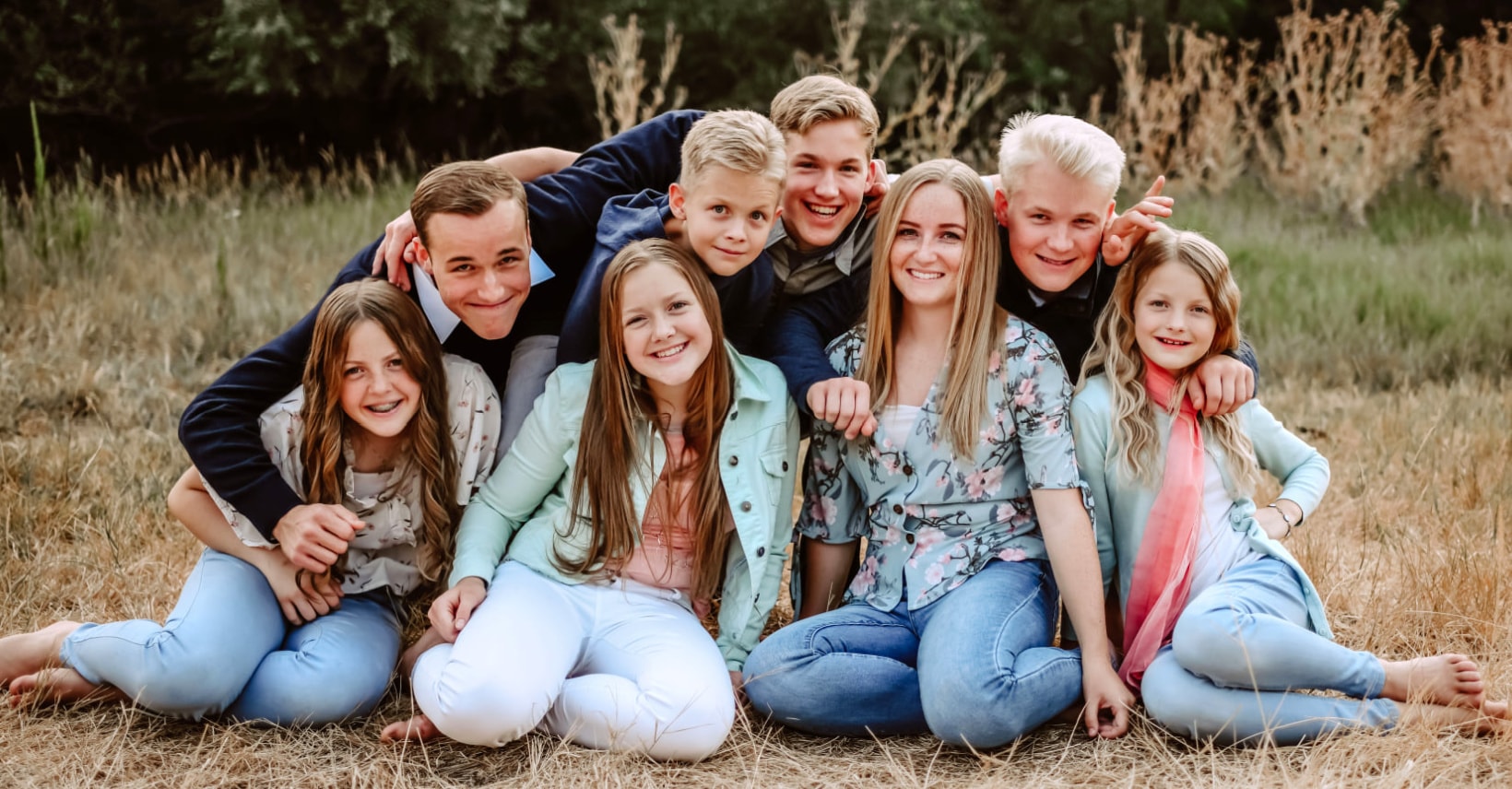
They were raised in essentially the same soil: the same home, the same parents, the same family culture, and many of the same expectations, opportunities, values, rules, mistakes, traditions, and dinner-table conversations.
And they are completely different people.
Some have grown up and planted themselves in Italy, Washington, D.C., Kansas City, Chicago, and Salt Lake City. Some are still growing here at home.
Their dreams are different. Their interests are different. Their gifts are different. Their paths are different.
They are building lives I could not possibly have drawn on a blueprint when I first held them.
And thank goodness.
Maybe not knowing exactly what is inside the seed is part of the fun.
We get a front-row seat while another human being becomes.
We get to discover who was inside that seed all along.
We get glimpses along the way. A strange interest appears. A strength we did not teach them. A way of seeing the world that is completely different from ours. A capacity develops years later than we expected. Something we worried about becomes one of their strengths. A branch grows in a direction we never would have chosen.
We spend so much time talking about relinquishing control as though it is one of the great sacrifices of parenthood.
Fine. I guess I can’t control who my children become.
But what if not knowing is one of the privileges?
I do not need to know exactly what is inside each seed to know what my work is.
I can provide good soil. I can pay attention. I can respond when something is wrong. I can cultivate courage, honesty, responsibility, and curiosity. I can teach, protect, guide, correct, love, apologize, hold boundaries, and keep showing up.
And then I get to stand back and say:
Look at that.
I didn’t make that.
I helped create a place where it could grow.
Of course our influence is real. Plants can be deprived of what they need. They can be crowded, neglected, overwatered, or exposed to conditions they aren’t ready to withstand.
But recognizing our influence does not require pretending we have control. At some point, parenting requires us to cultivate well and then trust a process we cannot control.
The seed has its own work to do.
So do we.
Mine, apparently, was to keep a terracotta donkey’s sombrero damp and stop staring at it every fifteen minutes.
The chia seeds sprouted on day three, and the foliage was full by day seven.
The seeds were not behind.
They were not failing.
Nothing was wrong with the seeds that morning.
They were simply doing something I could not see yet.
And how many times, in my hurry to see something green, have I been tempted to dig?