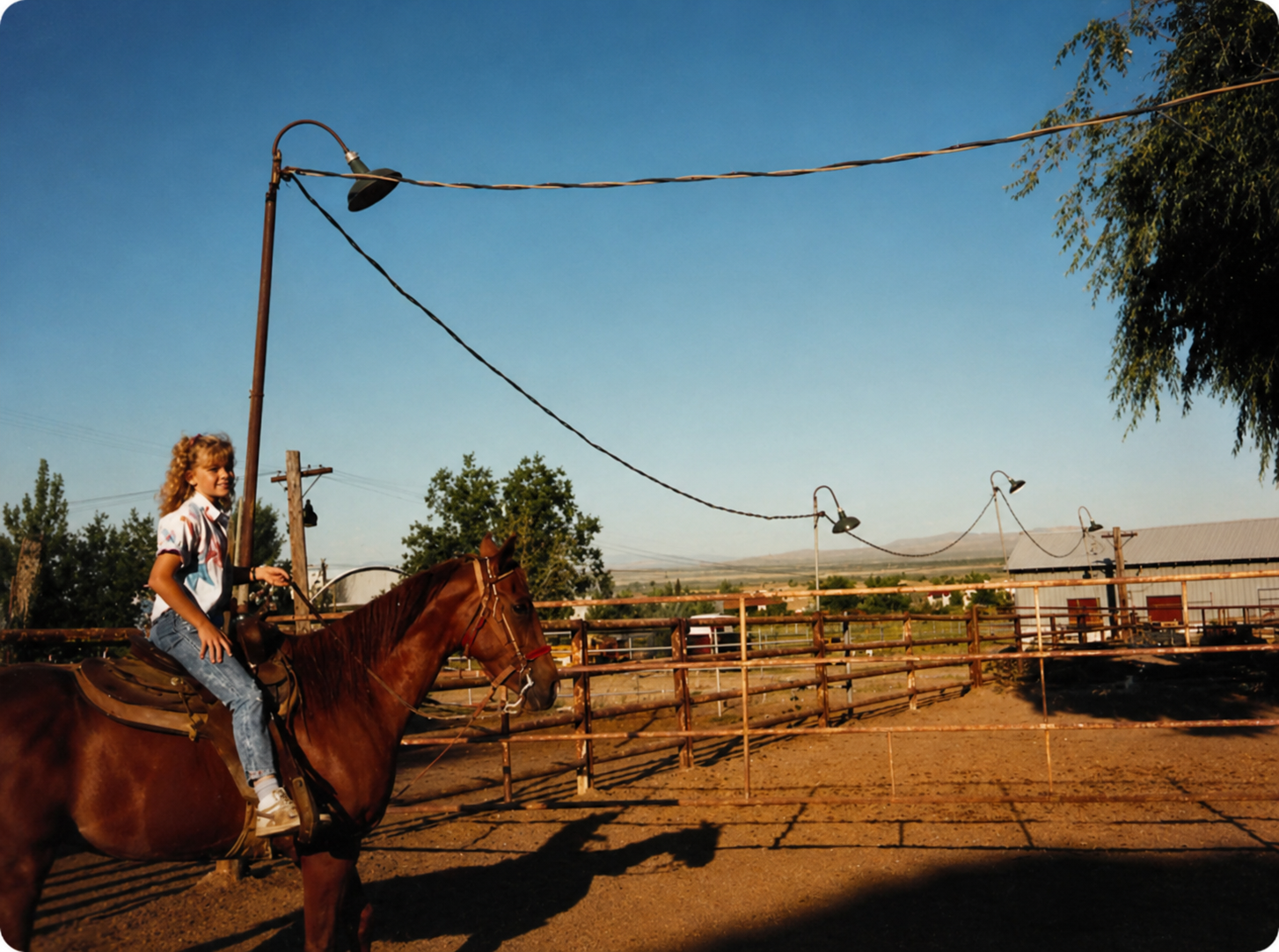
When I was ten years old, I wanted to be a horsewoman.
My grandpa was exactly the person to teach me. He knew everything there was to know about horses. His stable yard was full of them. He was a gruff man, and yet horses that spooked easily would settle the moment he walked into the barn.
They trusted him.
I wanted to learn everything he knew, so one summer morning I showed up at his barn convinced my new life as a cowgirl was about to begin.
He handed me a pitchfork.
The stalls needed cleaning.
So I scooped manure. Then I hauled five-gallon buckets to fill the watering troughs. As a ten-year-old girl, those buckets felt like they were filled with concrete. Then I carried hay to every stall and grain to the racehorses.
By the time we finished, I was exhausted and hadn't gone near a saddle.
I worked up the courage to ask, "Grandpa... when are we going to ride?"
His eyes twinkled, but he didn't respond.
The following day looked the same.
More stalls. More buckets. More hay.
Before I knew it, a week had gone by. Every morning I showed up convinced this would finally be the day. Every morning there was another job waiting for me.
If Grandpa was trying to discourage me, it didn't work.
I just kept showing up.
Looking back, I realize Grandpa wasn't trying to find out whether I wanted to ride. He was trying to find out how badly I wanted to become a horsewoman.
Those are two very different things.
One morning, Grandpa looked at me and said, "Let's saddle up."
From that day on, after the chores were finished, we rode.
I learned a lot that summer. That first lesson was especially memorable: "If you hold the reins too tight, you'll make a horse anxious. You've got to give him his head."
The concept wasn't intuitive. This horse weighed close to a thousand pounds, and I weighed seventy. Every instinct I had said: Hold on tighter.
Tight reins felt safe. Responsible. Like what a horsewoman was supposed to do. And that makes sense to me. You don't throw the reins over a horse's neck and hope for the best. Reins matter. Guidance matters. Boundaries matter.
But Grandpa wasn't telling me to stop leading the horse. He was teaching me how to lead it. So I loosened the reins. Just a little.
Almost immediately the horse changed. He became softer. More relaxed. More responsive.
At ten years old, I thought Grandpa was teaching me how to ride horses. It would take me years to realize what else he was teaching me.
I thought about him recently during a coaching call with a father who was frustrated by his twelve-year-old son's habit of telling small lies. He was, by all accounts, a devoted parent. The kind who shows up, pays attention, and cares deeply about doing things right.
"I don't understand," he said. "When I yell at him, his behavior improves. When I ground him, his attitude changes. He straightens up almost immediately."
He paused.
"But he doesn't look me in the eye as much. He makes excuses. And he tells lies."
I could hear how worried he was.
He wasn't trying to control his son for the sake of control. He was afraid that small lies might eventually become something larger. He wanted his son to grow into an honest person.
So he did what made sense.
He tightened the reins.
And in the short term, it worked.
His son's behavior changed.
But I asked him something I couldn't stop thinking about:
Can tightening your grip backfire?
Because something else seemed to be changing too.
I asked him, "What do you hope your son learns from all of this?"
He didn't hesitate.
"I want him to be responsible. I want him to make good choices because they're the right choices. I want him to know I love him."
That last sentence stayed with me.
Because there was nothing wrong with what this father wanted.
And there isn't necessarily anything wrong with consequences either.
Children need limits. They need guidance. Sometimes they need to experience the uncomfortable results of their choices.
But the question I found myself wondering about was subtler.
What was his son paying attention to?
The choice he had made?
Or the consequence he was trying to avoid?
I thought again about Grandpa's horse.
When I pulled too hard on the reins, the horse became preoccupied with the pressure in his mouth. He wasn't thinking about where I wanted him to go.
He was thinking about me pulling.
And that is where tightening the grip can backfire.
Not because control never works.
But because it can shift attention away from learning and toward avoidance.
I wonder if something similar can happen between people.
Sometimes pressure changes behavior quickly. That's part of what makes it so tempting.
The phone gets put away.
The room gets cleaned.
The attitude changes.
The lie gets replaced by a better one.
From the outside, it can look like progress.
But behavior is only part of what we're trying to shape.
We are also trying to raise people who eventually make decisions when we aren't standing beside them holding the reins.
That requires something harder to measure.
Judgment.
Responsibility.
Trust.
And perhaps enough room to make a choice.
I've thought a lot about Grandpa since that conversation.
He wasn't a permissive man. Not even close.
There were rules in his barn. There was work before riding. Horses had to be cared for before we did what we wanted.
He expected things from me.
But once I was in the saddle, he taught me something that initially felt like the opposite of good leadership.
Loosen your grip.
Not because direction doesn't matter.
Because it does.
Just enough for the horse beneath you to find its footing.
I can still remember being ten years old, seventy pounds on the back of a thousand-pound animal, every instinct telling me that safety meant holding tighter.
Grandpa knew better.
He handed me the reins anyway.