
Last fall, four outlets in our basement stopped working. Not four outlets next to each other. Four outlets spread across three different rooms. Other outlets on the same circuit still had power.
This apparently made no sense.
We called an electrician. He spent hours in our home. He tested the outlets. He tested the circuit. He pulled the covers off. He traced what he could trace. He left perplexed.
We called another electrician. Then another. Then another. Four electricians eventually looked at this problem, and all four of them came to essentially the same conclusion: The outlets should have been daisy chained together. That is how houses are normally wired. Power comes into one outlet and then continues to the next one and the next one. If something fails, you can usually work your way backward through the chain until you find where the connection was lost.
Except there was no chain. The electricians could find individual wires going toward the outlets. They could find power elsewhere on the circuit. But they couldn't find the connection between them.
Eventually, they decided that whoever had finished our basement was an amateur and had done something you are not supposed to do. Instead of connecting everything in accessible electrical boxes, they had apparently brought at least five wires together into a junction somewhere inside the ceiling or walls. And then they had sheetrocked over it. There was no box. No access panel. No indication of where it was. It could have been almost anywhere.
One electrician told us they could start cutting holes in the basement ceiling and walls and possibly still never find it. But there was another option. They could cut into the wall near the outlets we cared about most, find a different hot wire and tap into it. We could get those outlets working again without ever finding the original problem.
I talked to my dad about this idea. He did not like it. This would be solving a symptom, not a root cause. The original wire would still be inside the wall. Still connected to something. Still live. After all, several of the outlets on that circuit were working.
If we accepted the electrician's offer, we would have fixed the outlet without knowing what was happening behind it. It would have cost $1,500. And, by the way, electricians don't do the drywall repair.
So my 73-year-old parents drove several hours to help. For an entire day, my dad mapped the electricity in our house. Every outlet. Every switch. Every circuit. Every GFI. He flipped breakers on and off while he figured out exactly what was connected to what.
Then he started taking things apart. Outlet covers. Switch covers. Light fixtures.
He had one of those tiny cameras that can snake through a hole in the wall, and he pushed it into every opening he could find. He looked through walls. He looked through ceilings. He looked at wires disappearing into places we couldn't see.
At the end of the day, he put everything back together and drove home. The outlets still didn't work.
And then, sometime in the middle of the night, he woke up. He had been thinking about the map. The circuits. The directions the wires traveled. Everything he had seen through that little camera.
And suddenly he knew.
The next time he came to our house, he walked downstairs with a drywall saw. He cut a hole in the most random place at the edge of my son's bedroom ceiling. And there it was. A bundle of wires tucked above the sheetrock.
The spider junction. Five connections in all.
Whoever had put it there had connected the wires, slid wire nuts over them, taped them, and covered the whole thing up. Except some of the wires hadn't really been secured inside the wire nuts at all. It was almost surprising the connection had lasted two decades without giving us trouble.
My dad took the connection apart. He twisted the wires together correctly.
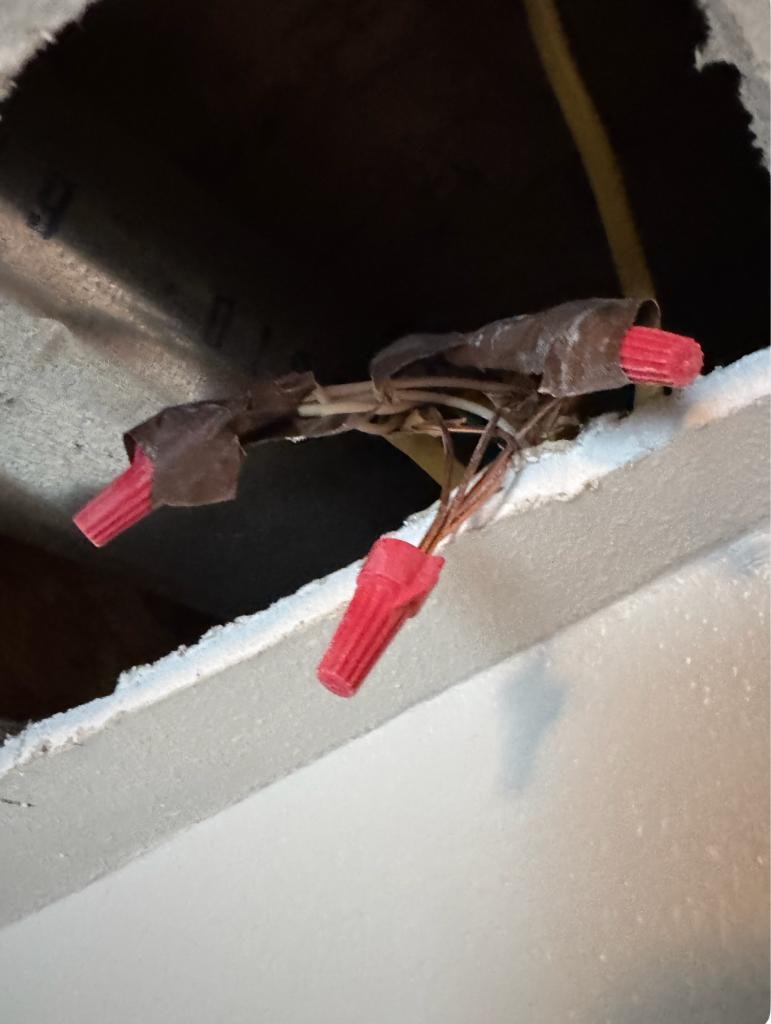
Maybe two turns. And suddenly every outlet worked.
Hours and hours of electricians. Three rooms. Four dead outlets. Circuit testing. Cameras inside walls. A house full of electrical mapping. And ultimately the problem was a connection hidden behind the ceiling that needed about two twists.
I had been thinking about that hidden junction for months before my dad ever found it. We knew there was a bad connection somewhere. We just couldn't see it. And in the meantime, all we could see were the places where it had stopped working.
I wonder how many connections in our own lives work the same way. Something happens, and we decide what it means. Or maybe someone else makes the connection for us and offers it to us as bedrock truth. Sometimes the connection is made so early, or repeated so often, that we don't even experience it as a connection.
It is simply true.
Good parents have happy children.
Fear means I am in danger.
Other people's opinions of me tell me something about me.
Once the connection becomes invisible, we start organizing our lives around it without realizing there is anything to question.
None of these sounds particularly outrageous. That is precisely what makes them interesting. Because hidden inside each one are two separate wires that we have connected together. And these aren't necessarily ridiculous connections. They may contain some truth.
Good parenting certainly affects children.
Fear sometimes warns us about danger.
Other people sometimes see things about us that we cannot see ourselves.
The electricians weren't stupid either. They were working from a completely reasonable premise: This is how houses are wired.
Usually, they would be right.
Just not in this house.
I think some of our most powerful premises are like that. They work often enough that we stop examining them. And then we build around them. Decisions. Habits. Relationships. Evidence. More conclusions. Eventually we put up the sheetrock. And after enough time passes, we no longer experience the connection as something that was made. It is simply how the house is wired.
Take one that sounds almost wholesome: Good parents have happy children.
Of course we want our children to be happy. Of course the way we parent affects them. But if I connect my child's emotional state to the quality of my parenting, something else happens. His unhappiness becomes information about me. And now I have a problem to solve. His disappointment is no longer simply disappointment. His anger is no longer simply anger. His struggle, loneliness, bad grade, or social problem isn't just something he is experiencing.
It is evidence.
Maybe I'm doing this wrong.
And if his unhappiness means I am failing, then of course I am going to try to fix his unhappiness. I might rescue when he needs to struggle. I might intervene when he needs to learn. I might have difficulty holding a boundary because I experience his anger as evidence that the boundary is wrong. I might become so frightened by what his experience says about my parenting that I cannot actually be present with his experience.
One small connection can power an enormous amount of behavior. And, ironically, in trying to manufacture a happy child, I may interfere with raising a resilient one.
Then there is another connection:
Fear means danger.
This one is compelling because sometimes fear absolutely is alerting us to danger. It can tell us that something isn't safe. It would be absurd to teach ourselves to ignore it.
But fear also shows up when we are doing things that matter enormously to us. When we are vulnerable. When we tell the truth. When we set a boundary. When we try something we might fail at. When we love someone without knowing how the story ends. When we attempt something bigger than anything we've done before.
Fear can mean: Danger.
And fear can mean: This matters, and I don't know what happens next.
The sensation itself doesn't tell us which one it is. But if those two wires have been connected and sheetrocked over—I feel afraid, therefore I should stop—we don't investigate. We retreat. And then retreat can become further evidence that fear was protecting us from something we shouldn't have done. The wiring reinforces itself.
The third example may be even harder to see:
Other people's opinions of me tell me something about me.
Someone says I am selfish or that I am a bad parent. Someone calls me difficult. And almost instantly, their words can become evidence in a case against me.
Maybe I am.
Other people's opinions aren't meaningless. Sometimes feedback is useful. Sometimes somebody else can see something we cannot. Sometimes criticism hurts because there is something in it worth examining.
But their opinion did not originate inside me. It occurred inside their brain. It traveled through their history. Their expectations. Their preferences. Their fears. Their needs. Their understanding of what a good parent or good person or good life should look like.
I can examine their opinion without handing it jurisdiction over me. Those are different things. And that distinction is exactly what gets lost when a connection goes unexamined.
Eventually we stop seeing two wires. We see one fact.
Good parent = happy child.
Fear = danger.
Their judgment = truth about me.
And often we have no reason to go looking behind the ceiling. Until something stops working.
Maybe the harder we work to keep our child happy, the less capable they seem of tolerating unhappiness.
Maybe the life we desperately want requires us to repeatedly walk toward things that frighten us.
Maybe we have spent years trying to become a person nobody could criticize and discover that person doesn't exist.
That is usually where we begin. At the outlet.
How do I make my child happy?
How do I get rid of this fear?
How do I get them to see me differently?
And sometimes there is absolutely nothing wrong with solving the problem at the outlet. Practical problems deserve practical solutions. None of this is an argument against changing circumstances. It isn't an argument for ignoring fear, disregarding feedback, leaving children to suffer, or becoming passive about our lives.
But sometimes we keep working on the outlet because we haven't realized there is another possibility.
Maybe the outlet isn't where the problem is. Maybe we need to map the circuit. To slow down long enough to notice what we have connected to what.
My child is unhappy. Does that tell me whether I am a good parent?
I am afraid. Does that tell me whether I am in danger?
Someone has an opinion about me. Does that opinion become evidence about who I am?
Sometimes the wires belong together. Sometimes they don't. And sometimes there is a relationship between them, just not the one we've assumed. The goal isn't to go through our lives ripping apart every connection we've ever made.
That's not what my dad did. He mapped the system. He gathered information. He looked carefully. And then he went home.
I love that part of the story.
He didn't know where the junction was when he left our house. He simply understood the system better than he had that morning. And sometime in the middle of the night, he saw something he hadn't been able to see before.
Maybe insight works like that.
We don't always have to wrestle a belief to the ground and replace it with a better one. Sometimes we get curious. We map. We notice. We separate the wires long enough to actually see them.
And maybe the problem isn't that we make connections. We have to. The problem in our basement wasn't that those wires came together. They needed to come together. The problem was that someone had buried the junction behind the sheetrock.
There is a reason electrical junctions are supposed to be left inside accessible boxes. You can find them. You can open them. You can see exactly what is connected to what. And when something stops working, you can examine the connection.
Maybe we need to leave our premises accessible too.
Not because every connection we've made is wrong. But because none of them should be buried so deeply that we forget they are connections at all.
When there is a problem, we can open the box and take a close look at the wires.
Some of the most powerful changes begin when we question a connection we forgot we ever made.