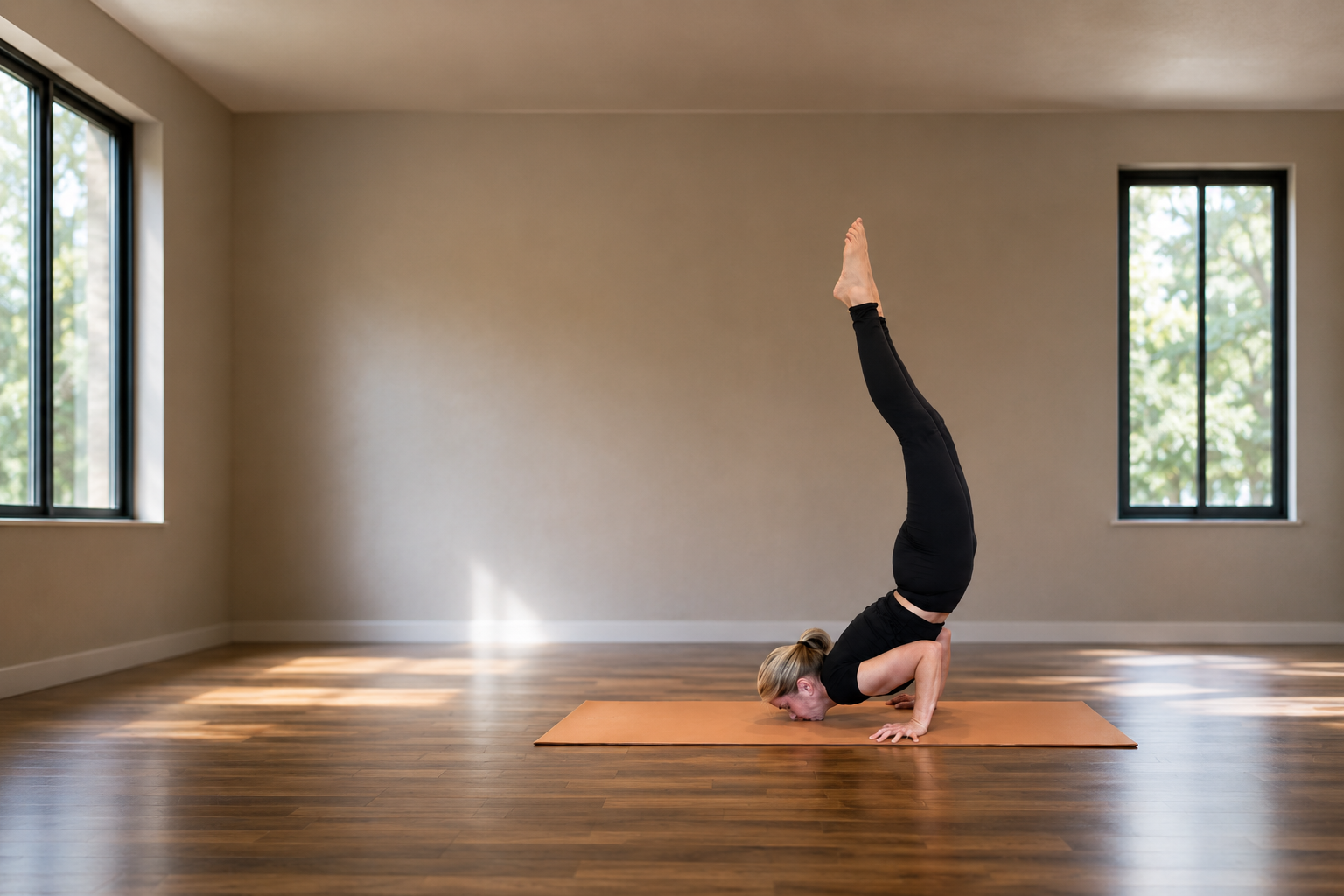
Across the yoga studio, I saw her suspended in midair, balanced on nothing more than the point of her chin. Her feet floated over her head. Her back curved like a drawn bow. There was no visible strain anywhere in her body. She looked less as though she were holding herself up than as though the world had briefly agreed to hold her instead.
As a certified yoga instructor, I know better. I know that yoga is not supposed to be about comparison, achievement, or expectation. I know all the language we use to soften the edges of wanting. But in that moment, all of that philosophy disappeared, and what remained was very simple and very human, almost embarrassingly so.
I wanted that pose.
After class, I asked her about it.
“Chin stand,” she said, as if it were nothing unusual at all. As if she had not just rearranged the laws of gravity in front of me.
I went home and did what we all do now when we encounter something extraordinary and slightly out of reach: I opened YouTube. There were tutorials, progressions, and slow demonstrations. Advanced instructors spoke calmly about where to place your shoulders, when to shift your weight, and how to lift your legs without collapsing your neck. There were videos with blocks, videos with walls, and videos with a spotter.
I tried all of it.
Nothing happened.
Actually, that isn’t quite true.
Something did happen.
I found myself crumpled on the floor over and over again, forearms shaking and breath uneven, as I began to understand that there was no version of those instructions that applied to me. I could follow every cue perfectly and still arrive nowhere close to the shape I had seen in the studio, as if there were a missing step no one had thought to mention.
The strange thing was that I wasn’t failing at chin stand. I was failing to reach the place where failure would even be instructive. The pose lived so far beyond my current ability that there was nothing meaningful to refine. I couldn’t adjust my alignment or work on holding it a little longer because I couldn’t get there in the first place.
Eventually, I stopped trying.
Not because I had lost interest.
I had simply run out of things to try.
So I went back to yoga.
Just yoga.
I showed up on the mat and practiced downward dog, plank, backbends, twists, and one-legged vinyasas. The same ordinary practice I had been doing for years without expecting anything in particular. Morning after morning, I rolled out my mat. Some days I felt strong. Some days I didn’t. Most days there was no obvious evidence that anything was changing at all.
About nine months later, I began noticing something strange. There was a new sensation in my back body. It wasn’t pain, and it wasn’t exactly strength either. The closest I can come to describing it is that I felt like I needed to go somewhere, as if my weight had begun to understand directions I had not yet learned how to name.
I noticed it first in three-legged dog. I felt unusually light, almost unanchored, as if my lifted leg were no longer a limb but a suggestion. Then I noticed it again during my one-legged vinyasas. My weight wanted to move differently.
For a few weeks, I simply noticed it. I didn’t connect it to chin stand. By then, I had mostly stopped thinking about chin stand.
Then one morning, I followed the feeling. I shifted my weight forward and gave a small hop, not because I expected anything, but because something in my body asked for it.
One leg lifted.
Then the other.
And for a moment, I was floating.
I was there.
The pose I had wanted so badly had simply appeared. I had practiced the same ordinary poses on repeat. I had built strength, balance, and awareness, none of which felt like chin stand. I had returned to the mat over and over, and somewhere inside all of those ordinary things, chin stand had been taking shape.
I think about that sometimes when I’m coaching parents.
Recently, I was talking with a mother about the person she hoped her child would become: responsible, confident, resilient, and kind. Independent enough to manage his own life while feeling secure enough to ask for help when he needed it. None of this was unusual. Most of us carry some version of this list around in our heads. We have a picture, however loosely drawn, of the adult we hope will eventually walk out of our homes.
And because we want these things so badly, we try to teach them. We remind a child to be responsible. We tell him to be confident. We explain why he needs to persevere. We tell him to be kind. We correct the behavior that doesn’t look like the person we hope he will become.
The mother I was talking with was doing all of this, and it wasn’t working particularly well. The harder she worked at responsibility, the more responsible she seemed to become for everything. She reminded him what he needed. She anticipated what he might forget. She stepped in when frustration threatened to overwhelm him. She was trying very hard to teach him not to need her, and increasingly, he needed her.
As we talked, I found myself thinking about chin stand. I had spent hours staring at the finished pose and trying to reproduce it. Maybe we do something similar with our children. We see responsibility and try to practice responsibility. We see resilience and try to teach resilience. We see confidence and try to persuade a child to be confident.
But what if those are the finished poses?
“What kind of home does a responsible person grow up in?” I asked her.
That changed the conversation.
We talked about a home where forgetting something could occasionally remain forgotten, where a mistake didn’t have to become an emergency, and where a child could struggle without the struggle immediately being removed. We talked about a home where help was available but didn’t always arrive before it was needed, where failure did not change the way people looked at you, and where adults made mistakes too, apologized, and tried again. We talked about a home where difficult feelings could exist without anyone needing to hurry them away, and where children were trusted with things they might not do perfectly.
None of those things were responsibility, confidence, or resilience.
They were simply the conditions around them.
I have taught parents before that if you have a plant with wilted leaves, you don’t lecture the leaves. You cannot force the plant to grow. You can only create an environment in which growth becomes increasingly likely.
You don’t have to teach a plant how to reach for the sun. You tend to the light, the water, and the soil.
It does what living things do.
It becomes.
Maybe this is some of what parenting asks of us: not to manufacture the finished person, and not even to know exactly who that person will be, but to become very interested in the conditions. What is practiced here? What happens when someone fails? How do we speak to each other? What do we believe about one another? What happens when life gets difficult? What does a child experience over and over again simply because this is the home in which they are growing up?
Perhaps character is being practiced there all the time, long before anyone knows what it will look like.
I had spent nine months thinking I wasn’t practicing chin stand.
In a way, I was.
I was practicing all the things from which chin stand could eventually emerge.
Maybe some of the most important things we want for our children are like that too. We cannot force the pose, but we can tend so carefully to what lies underneath it that one day, almost without our noticing, becoming it is the most natural thing in the world.