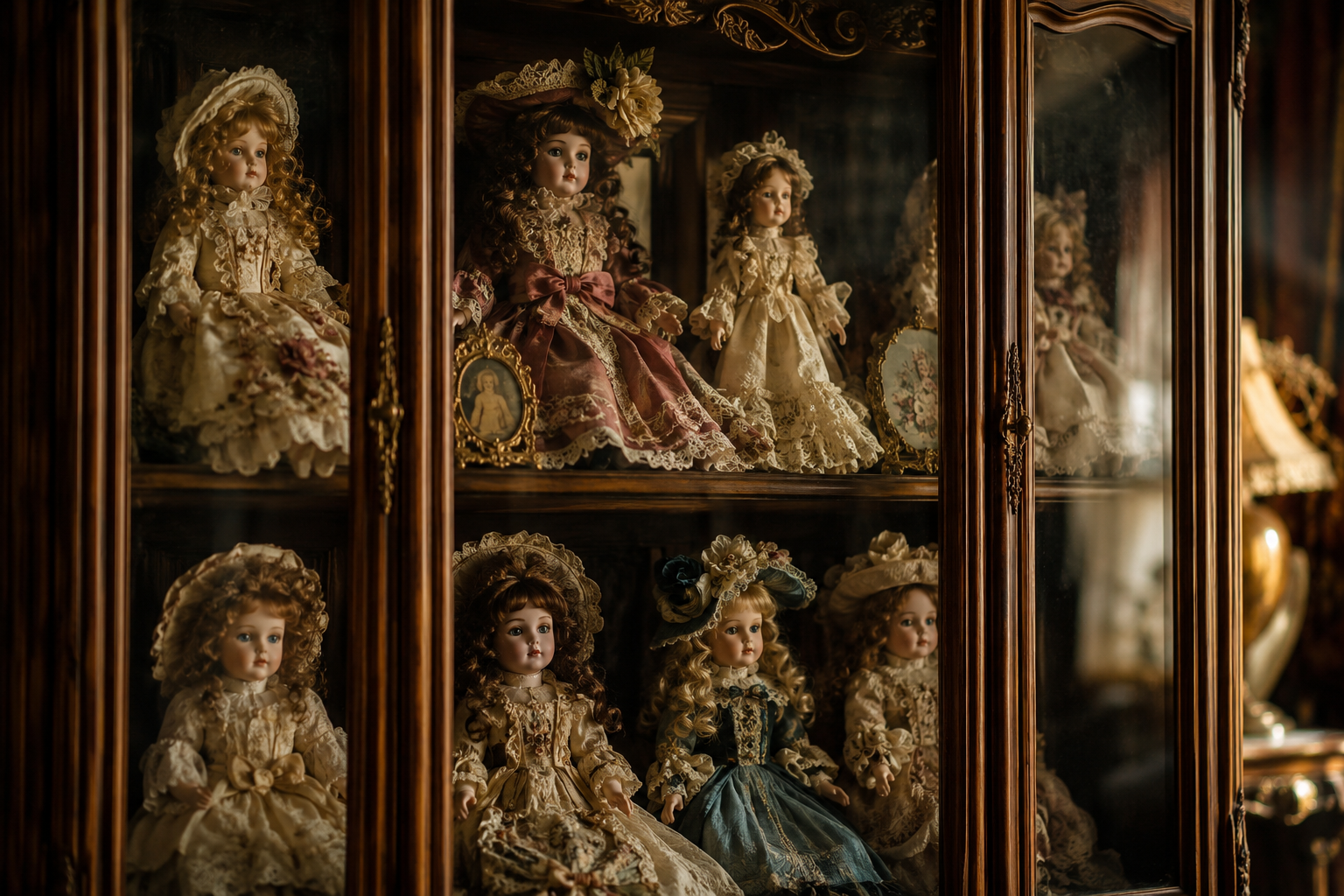
My grandmother's dolls lived behind glass.
Rows of porcelain faces stared out from polished wooden cabinets, each one dressed in lace, velvet, ribbons, and tiny leather shoes. She knew where every doll came from and could tell you who had given it to her or where she had found it.
Some were inexpensive, the kind you might find in a small shop or receive as a simple gift.
Others were collector's items: antique dolls with delicate painted features, rare editions. The kind of objects people insure and display carefully. The kind discussed in catalogs and auctions rather than living rooms.
To me, they were dolls.
To Grandma, they were treasures.
I've thought about that difference more than seems reasonable.
What makes something valuable?
The obvious answer is money. Some of my grandmother's dolls were worth considerably more than others. There were people willing to pay hundreds, perhaps thousands, of dollars for the right one.
But that doesn't quite solve the problem, because money itself is only valuable because we agree that it is. A hundred-dollar bill is a rectangle of cotton and linen with an elaborate picture printed on it, and yet it can buy dinner or a plane ticket because millions of us have agreed to behave as though it can.
Gold isn't much different. Neither are diamonds. We dig things out of the earth, assign them meaning, and then spend enormous amounts of time and energy acquiring them from one another.
This is normal enough that we rarely stop to consider how strange it is.
Then there are the things whose value makes even less sense.
A wedding ring might be worth a few hundred dollars at a jewelry store and become priceless the moment someone you love slides it onto your finger.
A crayon drawing that would not sell for fifty cents at an art auction can become nearly impossible to throw away because your five-year-old drew the people in your family with enormous heads and tiny stick legs.
The object hasn't changed.
Something else has.
We tend to talk about value as though it is a property things possess. This house is worth $800,000. This painting is worth $4 million. This diamond is worth $10,000.
But imagine, for a moment, that every human being vanished tomorrow.
The diamonds would still be diamonds. The Mona Lisa would still hang in the Louvre. Stacks of hundred-dollar bills could sit untouched inside bank vaults. My grandmother's dolls could stare out through their glass cabinets for another hundred years.
Nothing about the objects would have changed.
And yet something enormous would be missing.
There would be no one left to care.
I've spent years sitting across from people in coaching conversations, and somewhere along the way this question started following me there.
People don't come to me wanting to discuss the nature of value. They come because a marriage is struggling, a child is making choices they don't understand, something they wanted didn't work out, or someone they love is disappointed in them.
The circumstances change. But underneath them, I often hear some version of the same question.
What does this say about me?
Am I still enough?
Do I have value?
I understand the question.
I've asked it too.
But lately it has begun to strike me as strange.
We spend so much of our lives trying to acquire the very thing we seem to be responsible for assigning everywhere else.
We accomplish things. Become useful. Make money. Raise children. Try to be attractive enough, successful enough, good enough. We collect evidence, as though worth were something that could accumulate until eventually there was enough of it to settle the question.
And these things matter. Accomplishment can be deeply meaningful. Being loved changes us. Other people can see things in us that we cannot see in ourselves.
But I wonder if we've confused evidence of value with its source.
When my grandmother died, her dolls remained.
So did the cabinets. So did the lace dresses and tiny leather shoes.
Some of the dolls were still objectively valuable, at least in the sense that another collector would have paid money for them. But that wasn't what any of us talked about. We talked about Grandma. We remembered how she always chose the perfect birthday gifts, how she could find a bargain anywhere, how her long fingernails would gently scratch our backs.
We didn't mourn the collection.
We mourned the collector.
Some of the dolls went to family. Some were sold. I don't know where most of them ended up. Perhaps one of the expensive ones is now behind another pane of glass, treasured by someone who knows its maker and edition and market value. Perhaps one of the inexpensive ones ended up with a great-granddaughter who would never sell it.
Which one is worth more? I'm no longer sure the question has a sensible answer.
A house becomes home because someone lived there. A song becomes our song because two people danced to it once. A Tuesday in July becomes important because it was the last ordinary afternoon before everything changed. A porcelain doll becomes a treasure because my grandmother loved it.
For most of my life, I assumed she treasured those dolls because they were valuable. Now I wonder if I had the direction backward. Maybe value is not something we find in the world so much as something that emerges when we care about the world.
And if that's true, I find myself wondering why we spend so much of our lives waiting for the world to settle the question of our own.
After my grandmother died, the dolls were still there. Same porcelain faces. Same lace dresses. Some still worth hundreds of dollars. But the person who had looked through the glass and called them treasures was gone. I've never looked at dolls quite the same way since.
For most of my life, I thought my grandmother treasured those dolls because they were valuable. Now I wonder how much of their value began with her.
Perhaps the valuable things in our lives were never the source of our worth. They were borrowing it from us all along.